

Responsibility down to the Smallest Detail
Architecture emerges through the interaction of all relevant service profiles. We work on projects across work phases 1 to 9, either as a complete commission or in selected partial services, as object planners or lead consultant, from concept design to detailed design and through construction management.
Interior design, landscape architecture, urban and district design as well as project management are equally part of our service portfolio. Revitalisation and conversion are more important today than ever; sustainability is not only an integral component of all planning but a concrete strategy.

Architecture
Good architecture is, for us, more than the design of buildings. Even in times of social, ecological, and technological transformation. We develop architecture that contributes to quality of life in evolving living environments and densifying cities.
We create architecture and spaces that respond to the needs of their users. We draw inspiration from our broad spectrum of expertise and from our openness to innovative and experimental approaches. Our design culture is based on experience, collective creativity, and dialogue.
Through co‑creative processes, we combine our expertise from the first idea to handover and rely on the triad of design, detailed planning, and construction management. Technological and functional requirements are integrated from the outset, supported by digital tools such as 3D planning, BIM, virtual reality, and artificial intelligence.


Construction Management
Our construction management is integrated into the project team from the outset. This ensures a seamless transition from planning to implementation and guarantees that our high quality standards are consistently upheld on site. This results in buildings that reflect the design intent while remaining within cost and schedule.
Our team of specialists for cost, tendering, scheduling, and site supervision accompanies each project from commissioning. We ensure robust calculations, clear interfaces, and proactive coordination of all trades. We work closely with the design teams throughout.
We understand construction management as an integral component of the planning process. Close collaboration with design and planning safeguards the architectural concept during implementation. This interaction fosters a shared sense of responsibility for a high‑quality, cost‑ and schedule‑compliant outcome.


Lead Consulting
Complex building projects require clear responsibility and forward‑looking management. As lead consultants, we assume overall responsibility for the planning process and for overseeing implementation. For clients, this means having a single contractual partner: HPP Generalplanung GmbH. We coordinate all contractually required planning services and ensure a structured process across all phases.
We integrate our architectural services and all specialist planning required for the scheme and manage the entire process from a single source. HPP Generalplanung GmbH, a wholly owned subsidiary of HPP Architekten GmbH, acts as lead consultant for architecture and interior architecture and, together with subcontractors, for example for:
- Structural engineering
- Building services engineering
- Building physics
- Acoustics
- Traffic planning
- Landscape architecture
- Fire protection
- Health and safety coordination
- A single contractual and contact partner for all planning services
- Significantly reduced administrative effort
- Elimination of liability risks concerning interface coordination
- Selection of qualified planning teams via the HPP network
- Assumption of classical client tasks in cost, schedule, quality and contracts
- On‑schedule and on‑budget delivery with high planning quality


Project Management
Complex construction projects require forward‑looking management, clear structures and reliability, a clear roadmap for the team. HPP Projektmanagement GmbH assumes this responsibility nationally and internationally. As representatives of our clients’ interests, we manage quality, cost and schedule across the entire development, and life cycle of a property, relieving clients of all delegable tasks.
Project management means more to us than coordination: we see ourselves as active partners and moderators who handle organisation, review, coordination, and documentation from the first idea through to commissioning. We rely on tailored tools and methods that respond to the specific requirements of each project. You define the goals, we steer the course.
For each project, we assemble an experienced, interdisciplinary team that ensures continuity and efficiency throughout its duration. We manage and monitor all schedules, ensure transparent cost control and uphold defined quality standards. Through targeted support, clear processes, and an open communication culture, we create an environment in which ambitious goals can be achieved and innovative solutions can emerge.


Sustainability
Sustainable concepts are, for us, a basic prerequisite for our architecture. We develop projects that align ecological, economic and social objectives. Principles of circular economy and sufficiency are considered consistently from material selection to CO₂ accounting, both in design and implementation.
The requirements arising from ESG and EU taxonomy fundamentally change how buildings are designed, assessed and financed. Over 40% of global CO₂ emissions arise in the building sector. We respond to this responsibility with measurable solutions. We understand sustainability as an integrated design process along the entire value chain: interdisciplinary, knowledge‑sharing and uncompromising.
With pilot projects and pioneering schemes, we have set standards early on, supported by solid expertise in DGNB and BNB certifications, verification for the QNG label, life‑cycle assessment (LCA), life‑cycle costing (LCC) as well as strategies for circular economy and climate‑appropriate construction.
Sustainability has its greatest impact in early design phases, when decisions on materials, construction, and resource use are still open. This is precisely where we begin.
With targeted smart‑start simulations, we create orientation and planning certainty during the concept phase. We develop strategies for implementing regulatory requirements, from ESG and EU taxonomy through to project‑specific strategies for new builds, existing buildings and operation.
Our certification support for DGNB and BNB, including verification for the QNG label within the BEG funding framework, is an integral component of the planning process.
We directly link digital material passports with our BIM models. This enables early analysis of deconstruction potential, ecological impacts (LCA), and life‑cycle costs (LCC), a reliable foundation for investment and resource decisions across the entire life cycle.
Certifications
DGNB (buildings & interiors): pre‑check, criteria management & coordination, auditing (incl. documentation)
BNB: pre‑check, coordination and auditing
QNG: conformity assessment & documentation (project‑specific, according to funding guidelines)
ESG & EU Taxonomy
Taxonomy QuickScan with traffic‑light score, action plan and consulting
DGNB ESG verification for EU taxonomy compliance
Life-cycle assessment & costing
Strongly simplified life‑cycle assessment (early phase) for component comparisons and early decisions
Complete LCAs in accordance with DGNB, BNB and QNG
LCA and LCC according to relevant DIN/EN/ISO standards
Smart‑start simulations
PV quick check (surface potential & yield estimation)
Sun & shade (solar exposure/daylight conditions)
Daylight Lite (daylight indicators, variant comparison)
Deliverables: decision memo and graphics per variant (1–3 pages)
Strategies for operation and existing buildings
Decarbonisation roadmap: measures, pathway, CO₂ price effects
Circularity & material strategy: low‑pollutant design, deconstruction, urban mining, tender recommendations
Circularity & material consulting
EPD shortlist (material‑specific preselection based on environmental impact & availability)
Re‑use strategies (component reuse, secondary materials)
Material passports and integration into registers (e.g. Madaster)


Landscape Architecture
In view of the ecological challenges posed by climate change, we have deliberately chosen to align architectural development more closely with open‑space design. By incorporating the landscape architecture office +grün into our company structure, we strengthen interdisciplinary collaboration. This provides lasting benefits to our designs.
Our projects are developed in interdisciplinary teams, within Germany together with our subsidiary +grün Landschaftsarchitektur, and internationally directly with the local HPP team. Collaboration begins early and is an integral part of the overall process. This ensures that architectural concepts and landscape design are aligned from the outset.

Interior Design
Interior architecture combines functionality with emotional impact. We design spaces that place people at the centre and, given the high pace of change, respond to evolving user needs, hybrid working models, and flexible typologies. Functions and typologies increasingly merge, and the demand for multifunctionality continues to rise.
Each task results in an individual outcome. We engage with the brand language and develop our concepts accordingly.
Our approach is holistic, from the first sketch to the completed project. Our task is to understand the culture, the challenges to be addressed and the needs of the users and the wishes of the client, and to translate them into a new spatial language. We support this process in an advisory capacity as well.
Our architectural experience directly informs our projects. This allows us to align interior architecture with the building in an interdisciplinary dialogue. We develop solutions that are functional, identity‑forming, and adaptable, following a coherent design approach and in close coordination with all project participants.


Revitalisation, Conversion & Refurbishment
In decarbonisation, the existing building stock plays a central role. Re‑use strategies strengthen the connection to the built environment and open new opportunities for circular design and construction. We provide all work stages for the reuse and further development of existing buildings, with or without listed status. Our aim is to assess buildings within their structural and cultural context, preserve their fabric where possible, optimise use and energy performance and enable them for a new life cycle. Several HPP projects have already been prepared in this way for a second or even third life.
The foundation of our work is an intensive analysis of the building fabric:
- What is the identity of the building?
- Where lie its strengths and weaknesses?
- How much embodied carbon does it contain, and how can it be preserved intelligently?
- Is conversion feasible, i.e., a change of use of individual areas or of the entire building?
- Or is refurbishment, repair or (partial) demolition the more appropriate solution?
To answer these questions, technical aspects such as fire and acoustic protection, building physics, structural engineering, and acoustics must be clarified. We develop planning solutions in dialogue with our clients. For listed buildings, we involve the relevant authorities at an early stage. This enables decisions that lead to appropriate solutions.


District Development & Urban Design
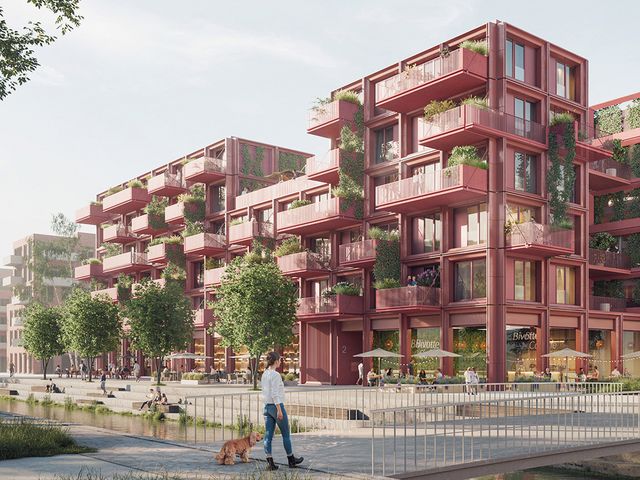
How do we want to live tomorrow? With our concepts, we respond to urban challenges such as climate change, population growth, and mobility. We develop ideas across different planning scales, from the district level to the design of entire cities. We understand the “smart city” both as a technological vision and as a liveable, resilient, and multifunctional urban environment where diversity, density, identity, and health intersect.
Our urban design plans are developed interdisciplinarily, drawing on perspectives from architecture, urban design, and landscape architecture. With digital 3D studies and virtual models, we examine variants for their spatial and functional qualities, increasingly with the integration of computer‑assisted parametrics and AI. With custom‑developed visualisation tools that generate city models in real time, as well as our “Urban Analytics” tool, we open up new possibilities for planning and communication.
In district development and urban design, we focus on shaping collective spaces for interaction and participation: green, social, and public realms within a dense, often monofunctional fabric. Urban design can thus become a driver of circular, inclusive and resident‑centred development and enhance the well‑being of people living in these environments.


